App-only / Note
Oriental Kopi has built an impressive business very quickly. FY2025 revenue reached RM450.9 million, up 62.6%, while net profit reached RM60.8 million. By May 2026, the company had 34 cafés: 31 in Malaysia and three in Singapore. Now Indonesia is next. Oriental Kopi has formed a joint venture with Erajaya Food & Nourishment, with Erajaya holding 60% and Oriental Kopi 40%. The initial rollout will focus on Greater Jakarta. The obvious question is whether Indonesians like Malaysian food. We think the more interesting question is harder: Can a concept built around a very specific Malaysian identity scale internationally without becoming less specific?
Neverlater
August 23, 2026
Shape your Neverlater
Follow the topics behind this signal
Following immediately improves For You, Daily Brief, and Notifications.
App-only note
The numbers matter because they show this is not simply a fashionable café concept.
Oriental Kopi generated RM450.9 million in FY2025 revenue and RM60.8 million in net profit. Café operations accounted for more than 90% of revenue.
Growth continued into FY2026.
Revenue for the six months ended March 2026 reached RM286.5 million, up from RM201.0 million in the comparable period, while profit for the period rose to RM32.1 million.
a proven home-market model.
But proven at home is not the same as proven abroad.
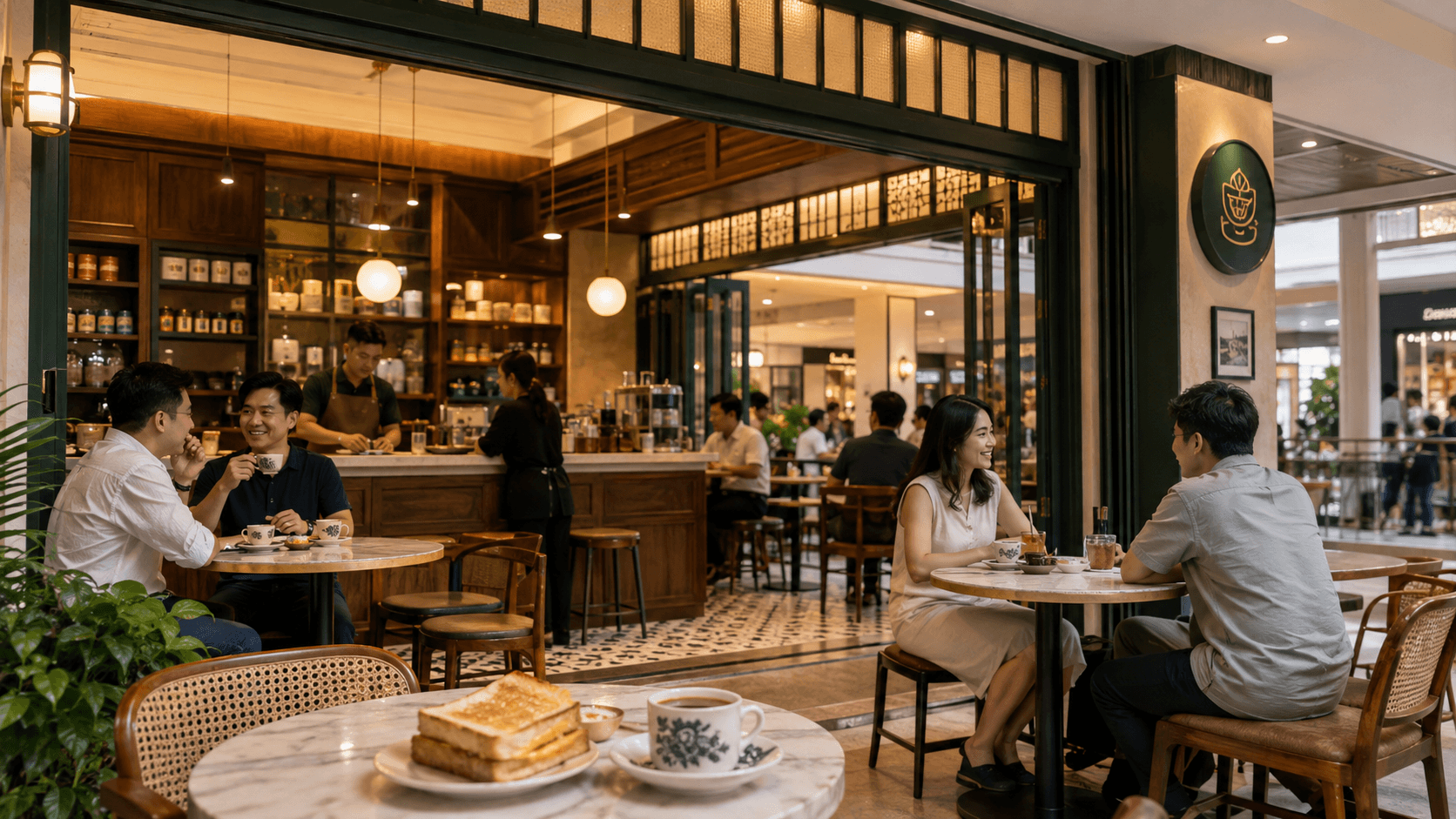
Oriental Kopi is built around more than coffee.
The proposition combines a modernised Malaysian kopitiam experience with products such as:
Its 2025 annual report highlights ASEAN records around kopi, polo buns and egg tarts, which reinforces how central signature products are to the brand.
That cultural specificity is an advantage.
It creates identity.
But it can also make international expansion harder.
This is why we would resist excessive localisation.
Indonesia already has an enormous number of coffee shops, casual restaurants and mall cafés.
Oriental Kopi probably does not win by gradually removing everything that feels Malaysian.
That would make the brand easier to understand.
It would also make it easier to replace.
preserve the cultural core, localise the edges.
Localisation should increase accessibility.
It should not erase identity.
Oriental Kopi is entering through Erajaya Food & Nourishment, not alone.
The JV is 60% owned by Erajaya and 40% by Oriental Coffee International. Oriental Kopi will support the Indonesian business with operational systems, recipes, service standards and brand identity.
That structure makes sense.
the foreign brand gets the headline, but the local operator often determines whether the expansion actually works.
Oriental Kopi is also a more operationally complex format than grab-and-go coffee.
A full café requires:
That creates higher revenue potential per store.
It also creates more ways for execution to break.
Queues during opening week tell us very little about those numbers.
Oriental Kopi is not purely a restaurant business.
Its FY2025 revenue also included packaged-food distribution and retail, and the company continues building its FMCG portfolio.
This matters for international expansion.
Restaurants create brand experience.
If executed well, Indonesia could eventually become both a restaurant market and an FMCG distribution market.
That is structurally more interesting than opening cafés alone.
Our view: Oriental Kopi should not try to become Indonesian too quickly.
The reason to visit is precisely that it offers something culturally distinctive.
The job is not to remove that difference.
The job is to make that difference easy enough for Indonesian consumers to adopt repeatedly.
If Oriental Kopi succeeds, the strongest proof will not be a busy first outlet.
It will be whether an unmistakably Malaysian format can become part of everyday Indonesian consumption.
That is how a local brand becomes a regional one.
Does the initial Jakarta store maintain traffic after novelty fades?
Which elements remain authentically Malaysian and which are adapted for Indonesia?
Can Oriental Kopi find a price point that supports restaurant economics without narrowing the audience too aggressively?
Erajaya’s Expansion Playbook
How quickly does Erajaya move once the first store economics become visible?
Does FMCG become an important second channel for the brand in Indonesia?
Can the concept eventually work in Surabaya, Bandung, Medan and other cities?
Does Indonesia validate Oriental Kopi as a genuinely regional consumer brand rather than primarily a Malaysian success story?
References
Sources used to support this Neverlater read.

Discussion
No approved comments yet. Be the first to add a thoughtful note.