Radar Signal
Our Read on iJOOZ’s Automated Fresh Juice Model
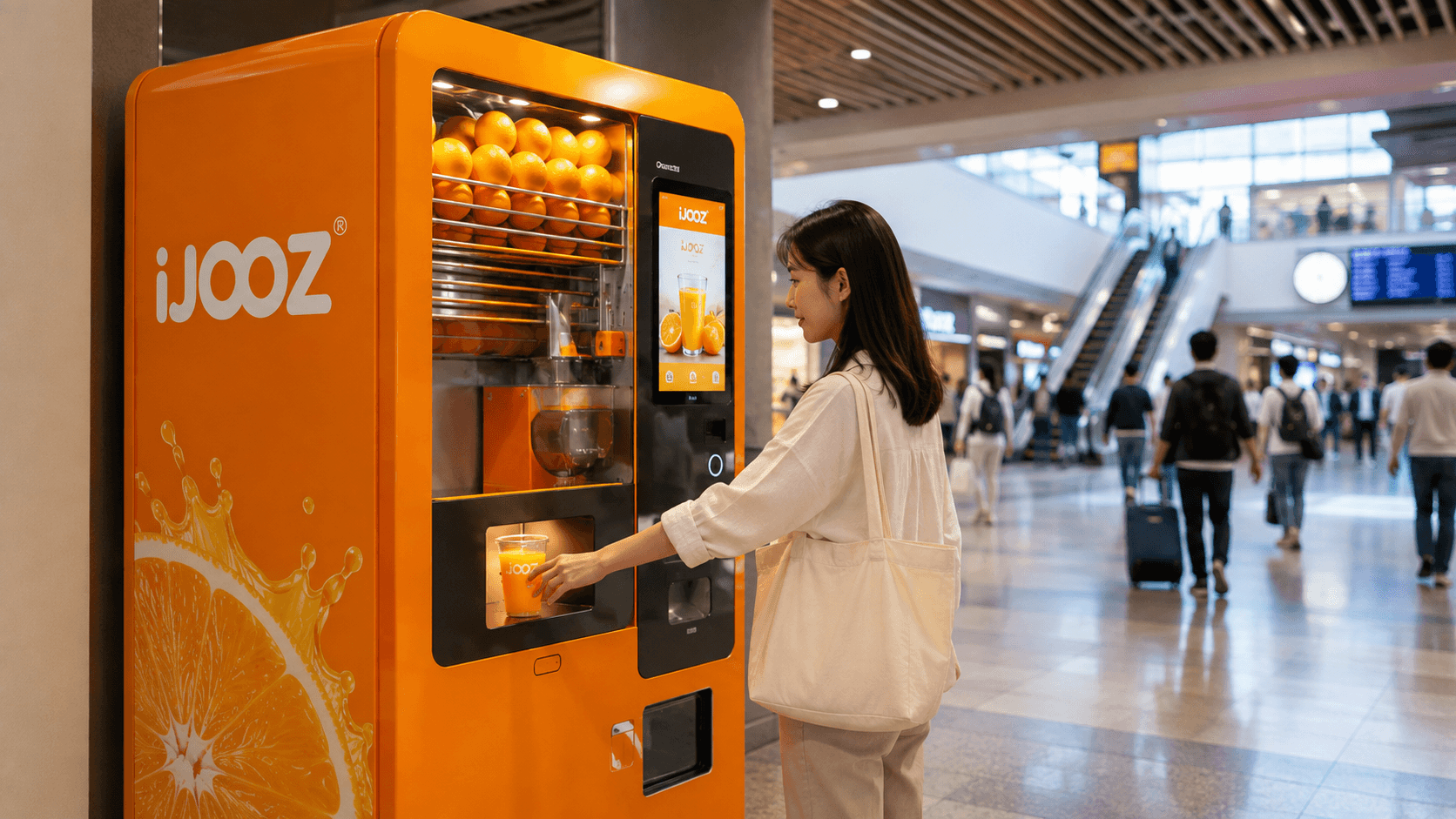
iJOOZ has built a large international network of automated fresh-orange-juice machines.
Neverlater Radar / August 11, 2026
Shape your Neverlater
Radar Signal
iJOOZ has built a large international network of automated fresh-orange-juice machines.
Neverlater Radar / August 11, 2026
Shape your Neverlater
Follow the topics behind this signal
Following immediately improves For You, Daily Brief, and Notifications.

Signal
iJOOZ has built a large international network of automated fresh-orange-juice machines.
The Singapore-founded company says it now operates more than 2,500 smart machines across 32 countries, with approximately 80% penetration of Singapore’s freshly squeezed orange-juice vending category.
Japan has become a particularly important market, with the company reportedly scaling to around 1,300 machines across high-density locations.
Why it matters
Fresh food is difficult to automate.
A conventional vending product is relatively simple.
Packaged drinks can sit in inventory.
Snacks can tolerate longer shelf lives.
If iJOOZ can automate those problems economically, the model becomes more than a vending concept.
It becomes a food-robotics system.
Neverlater read
Our view: iJOOZ’s real innovation is not putting a juicer inside a vending machine.
It is building the operating system that allows fresh food to behave more like automated retail.
That distinction matters.
Orange quality varies.
The machine still needs to deliver a reasonably consistent consumer experience.
The customer only sees a cup.
The complexity sits upstream.
It requires very little labour and very little real estate.
But low fixed cost does not guarantee good economics.
A poorly located machine can still fail.
What to watch next
Does iJOOZ continue toward its stated 2027 US listing ambition?
What sales level does a mature machine need to generate to remain attractive?
Can Japan maintain strong economics as network density increases?
Do operator returns remain compelling after location rent, servicing, fruit, and maintenance?
Can the technology extend into other juices or fresh-food formats?
As machines scale, food-safety incidents become increasingly important to brand trust.
The opportunity is clear, but pricing, replenishment, tropical storage conditions, and location economics would need local validation.

References
Sources used to support this Neverlater read.
High-density locations such as train stations, malls, hospitals, offices, and transit hubs naturally become attractive.
Once enough machines exist within one geography, operations can become more efficient.
The same replenishment team can service multiple machines.
Procurement volumes increase.
Data improves.
Routes become denser.
Maintenance response becomes faster.
More machines → better route density → lower servicing cost → stronger economics → more viable locations.
That may ultimately be more defensible than the machine technology itself.
iJOOZ actively promotes franchise partnerships.
That allows the network to expand without the company funding every machine directly.
Automation reduces labour.
It does not eliminate execution.
iJOOZ is best understood as a distributed fresh-food operating system.
The machine is simply the consumer interface.
If the company can consistently manage sourcing, replenishment, food safety, maintenance, and location economics across thousands of machines, the model can potentially expand well beyond orange juice.
That is where the broader food-robotics opportunity becomes interesting.
Discussion
No approved comments yet. Add the first thoughtful note.