Radar Signal
Our Read on O!Save’s Hard-Discount Bet in Indonesia
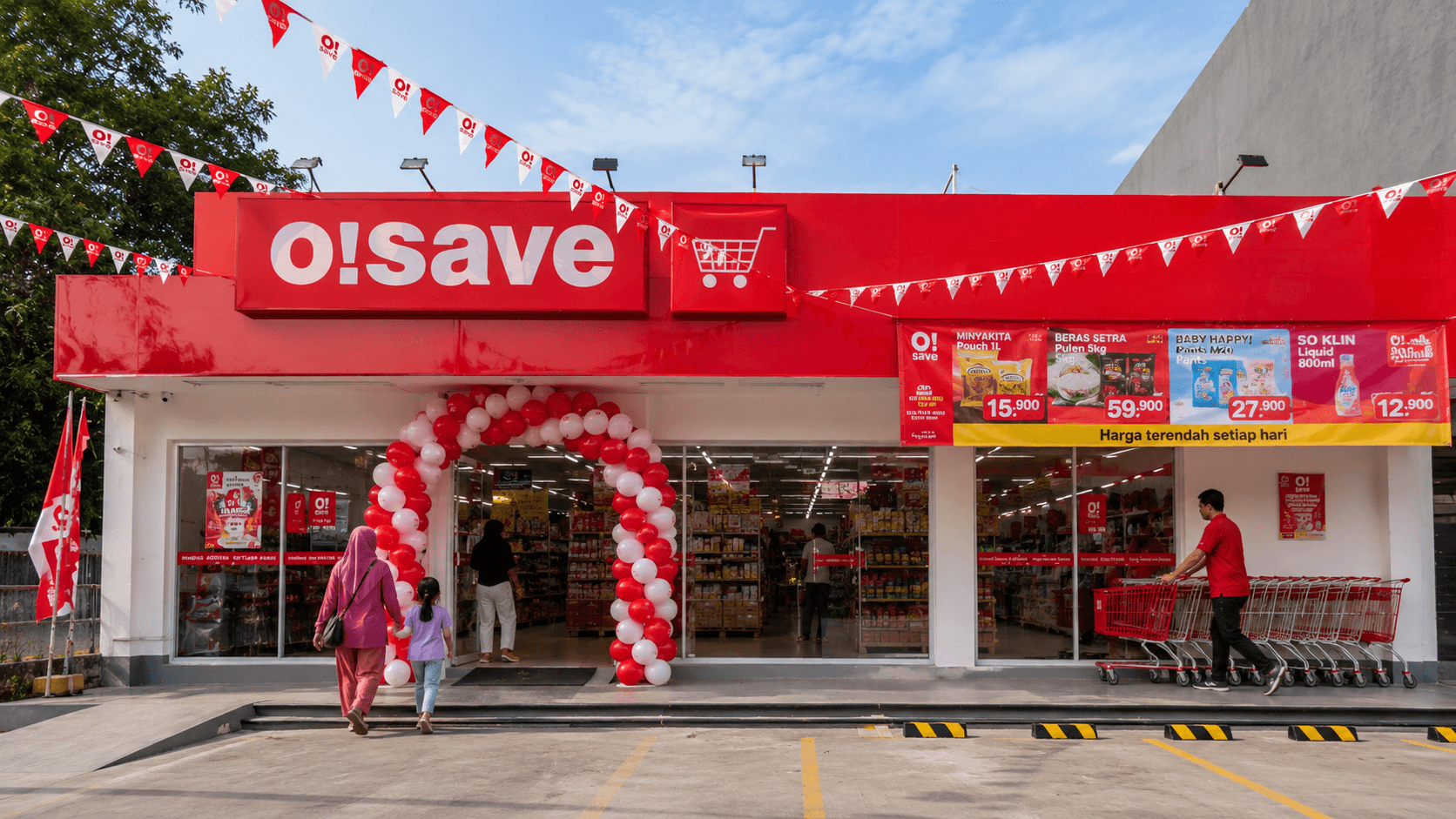
O!Save has been operating in Indonesia since 2023, positioning itself as the country’s first hard-discount retail network.
Neverlater Radar / August 14, 2026
Shape your Neverlater
Radar Signal
O!Save has been operating in Indonesia since 2023, positioning itself as the country’s first hard-discount retail network.
Neverlater Radar / August 14, 2026
Shape your Neverlater
Follow the topics behind this signal
Following immediately improves For You, Daily Brief, and Notifications.

Signal
O!Save has been operating in Indonesia since 2023, positioning itself as the country’s first hard-discount retail network.
Its model is deliberately different from conventional supermarket and minimarket retail.
O!Save says products can be displayed directly inside their cartons and on wooden pallets rather than individually merchandised across elaborate shelving.
The company also works with suppliers on developing private-label products, adding another potentially important layer to the economics.
Remove unnecessary retail cost so more of the value can show up in the price.
Why it matters
Indonesia does not lack grocery stores.
Alfamart and Indomaret already provide enormous convenience-store density.
Traditional trade remains deeply embedded.
Supermarkets serve larger planned baskets.
That makes O!Save interesting precisely because it is not another version of the same format.
Traditional minimarkets optimise around convenience.
Hard discount optimises much more aggressively around cost.
If O!Save can create enough consumer trust around that trade-off, Indonesia could potentially develop a meaningful third modern grocery format.
Neverlater read
Our view: O!Save is one of the more interesting retail models to watch in Indonesia because its innovation is subtraction.
More products.
Better interiors.
More technology.
More services.
More promotions.
What can we remove without meaningfully reducing the value customers actually care about?
That is a very different design philosophy.
Consumers naturally associate choice with value.
But operationally, too much choice creates complexity.
The consumer gives up some choice.
The retailer tries to return that efficiency through price.
O!Save’s cartons-and-pallets approach is intentional.
In conventional retail, visual simplicity may feel unfinished.
In hard discount, it can become part of the proposition.
We are not asking you to pay for an expensive store environment.
What to watch next
How quickly can O!Save build enough store density for procurement, logistics, awareness, and distribution economics to improve together?
How much does a representative household basket save versus Alfamart, Indomaret, supermarkets, traditional grocery, and wholesale formats?
Can O!Save build proprietary products that improve both consumer value and gross margin without weakening quality perception?
Will consumers adopt O!Save as part of their regular grocery routine, or primarily use it for occasional stock-up missions?
At what network size does O!Save need additional distribution centres and more sophisticated replenishment infrastructure?
Can hard discount work equally well across secondary Indonesian cities with different incomes, property costs, and shopping behaviour?
Does a lower-cost store format translate into sufficiently attractive sales density and basket size to produce healthy store-level returns?

References
Sources used to support this Neverlater read.
But this only works when the price difference is meaningful enough to justify the compromise.
If O!Save is only marginally cheaper, the trade becomes much less compelling.
O!Save is already working with suppliers on private-label development.
That matters.
It also makes direct price comparison harder.
A branded FMCG SKU can be compared immediately with Alfamart, Indomaret, Shopee and a local wholesaler.
A proprietary O!Save product cannot.
If quality remains acceptable, private label can strengthen both customer value and retailer economics.
The obvious comparison is the minimarket duopoly.
But O!Save may not primarily compete for the same convenience mission.
The real question is whether Indonesian consumers are willing to travel slightly differently to save meaningfully more on a planned basket.
Hard discount may look like a simple store format.
The infrastructure behind it is not simple.
The network itself can become the advantage.
O!Save does not need to be more convenient than Indomaret.
It needs to make consumers believe that accepting a simpler shopping experience produces materially better value.
If it succeeds, hard discount could become one of Indonesia’s most interesting modern-retail formats.
Discussion
No approved comments yet. Add the first thoughtful note.