
App-only / Note
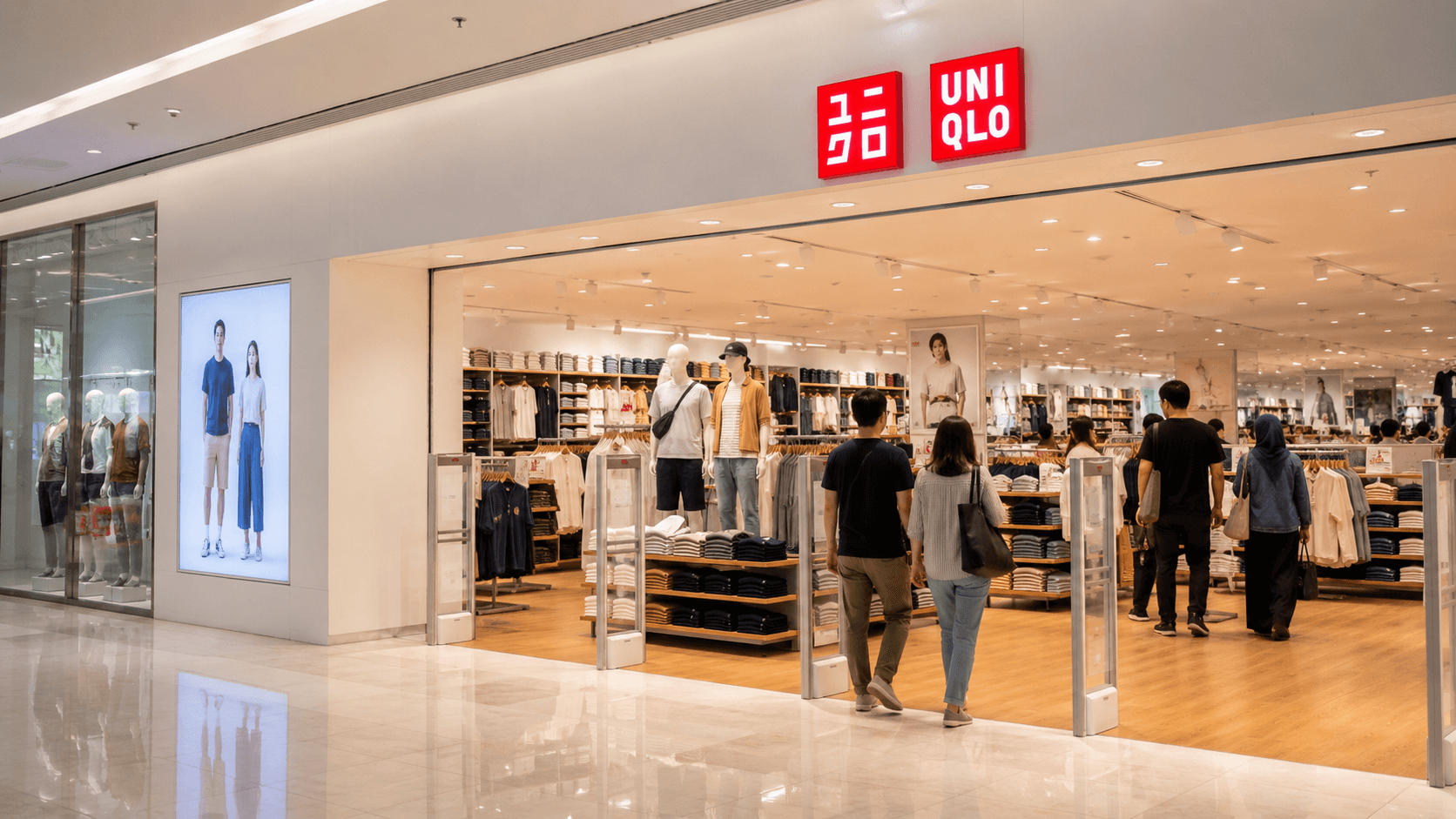
Uniqlo entered Indonesia in 2013. By July 2026, it had grown to 78 stores. That is already meaningful scale. But for a country the size of Indonesia, the more interesting question may be: Is Uniqlo still underdistributed?
Neverlater
September 3, 2026
Shape your Neverlater
Follow the topics behind this signal
Following immediately improves For You, Daily Brief, and Notifications.
App-only note
Uniqlo is no longer testing Indonesia.
It has been here for more than a decade.
Fast Retailing says Uniqlo operated 78 Indonesian stores as of July 31, 2026, up from 40 in FY2021 and 77 in FY2025.
That is substantial.
But Indonesia is also one of Southeast Asia’s largest consumer markets.
Should Uniqlo actually be moving faster?
Uniqlo has something many international retailers struggle to establish in Indonesia.
A clear reason to exist.
Functional basics.
Accessible premium positioning.
A wide enough price architecture.
Strong product consistency.
HeatTech may not define the Indonesian business, but AIRism, basic tees, modest layering, officewear, and everyday casual products fit the market naturally.
The brand does not need to explain itself from scratch.
That matters.
Indonesia is difficult to serve physically.
Population is large but dispersed.
Mall quality differs significantly by city.
Consumer spending power varies.
Logistics add complexity.
Still, Uniqlo has already shown it can expand beyond Jakarta.
The company’s own local initiatives now span more than 23 cities through its Neighborhood Collaboration program, suggesting the brand is increasingly operating beyond only the largest urban centres.
The next question is whether its physical network should follow.
The case for faster expansion is not simply “Indonesia is big.”
That would be lazy.
The stronger argument is convenience.
Fashion is still physical.
Fit matters.
Touch matters.
Trial matters.
Returns matter.
If consumers need to travel too far to reach a store, Uniqlo loses frequency.
More stores can therefore create value by making the brand easier to access rather than merely increasing headline footprint.
But this only works when mature-store economics remain healthy.
Uniqlo’s format relies heavily on:
good mall traffic,
large stores,
broad assortment,
high inventory discipline,
and significant working capital.
Those economics become harder in secondary locations.
A poorly located 1,500–2,000 sqm store can become expensive very quickly.
So aggressive expansion should not mean indiscriminate expansion.
The right question is not how many stores Indonesia can support. It is how many high-productivity Uniqlo stores Indonesia can support.
We think Uniqlo probably has room to become materially larger in Indonesia.
But the opportunity is not simply more stores.
It is better density in cities where the brand already has real demand, followed by selective entry into the next tier of markets.
deepen first,
broaden second.
Uniqlo already has product-market fit.
Now the question is whether it can turn that relevance into a much denser physical network without sacrificing store productivity.
Indonesia may not need 200 Uniqlo stores tomorrow. But 78 does not necessarily look like the ceiling either.
References
Sources used to support this Neverlater read.
Discussion
No approved comments yet. Be the first to add a thoughtful note.